

Workstream Deliverables
Planning for Data Center Demand: Forecasting Regional Load Growth with Interconnection Queue Data
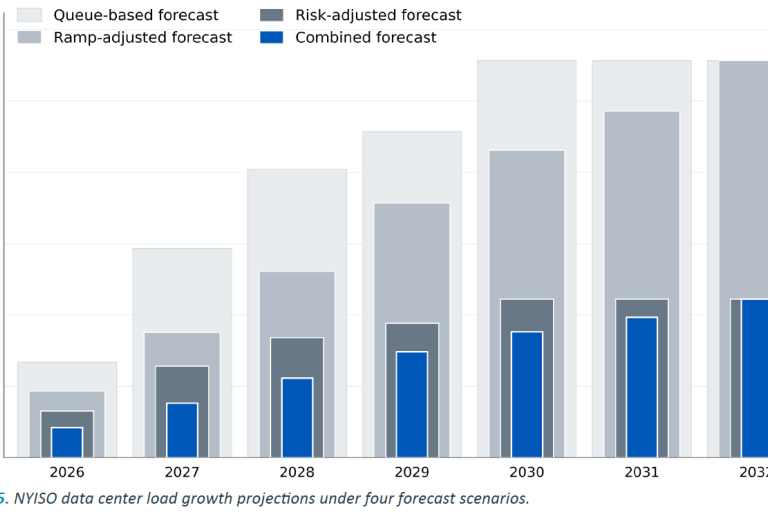
Interconnection queue data can provide valuable early insight into the potential scale, timing, and location of data center development; however, requested capacity alone is not a reliable indicator of future load growth due to uncertainties related to project realization, development timelines, load realization, and phased energization. This Quick Insight summarizes an EPRI framework that transforms interconnection queue data into planning-ready regional load growth forecasts. The framework incorporates project-level risk adjustments to account for project and load realization uncertainties and load-ramp adjustments to reflect the phased development of data center load following grid connection. The publication describes key considerations affecting forecast accuracy, outlines a structured approach for evaluating queued projects, and demonstrates application of the framework using publicly available interconnection queue data from the New York Independent System Operator (NYISO) and Bonneville Power Administration (BPA). The framework is designed to support utilities, system operators, planners, and policymakers in developing more informed forecasts of large-load growth from interconnection queue data and can be adapted to regional conditions and available project information.

Evaluating Resource Portfolio Readiness for Data Center Loads: Metrics and Approaches
This white paper introduces a set of metrics for assessing portfolio readiness in the context of data center load growth. It provides an overview of the challenges system resource planners encounter when integrating data center loads and introduces metrics that can be incorporated into the resource planning process to address these challenges. The paper also explores how these metrics fit within the broader portfolio planning framework. The developed framework and metrics were informed by an extensive review of existing frameworks and literature along with a series of expert interviews.

DCFlex Load Shape Library - Web Tool
The DCFlex Load Shape Library provides access to standardized hourly data center load shapes derived from measured power consumption data from multiple facilities. The library enables users to explore, visualize, and compare demand characteristics across different facility sizes, ownership models, and workload types.

Energy Supply Chain Resilience for Rapid Load Growth: Implications for Utilities and Data Center Expansion
This report examines the rapidly evolving supply chains supporting data center energy infrastructure amid accelerating load growth and increasing pressure on electrical generation equipment. Since EPRI’s 2025 assessment, the industry has reached several key milestones, including record-high gas turbine orders, longer transformer lead times, and the emergence of gigawatt-scale fuel cell procurement as a mainstream planning option. At the same time, solar power continued to dominate new U.S. generation additions despite a decline in total installations compared with 2024. To address ongoing supply chain constraints, manufacturers and developers are increasingly pursuing regionalized production strategies, backed by significant new investments in North American manufacturing capacity. Drawing on technology comparisons and interviews with utility procurement and supply chain leaders, this report provides an updated overview of the opportunities, challenges, and trends shaping energy supply chains for data centers.

Workforce and Data Centers: 2026 Update
This report examines the growing workforce challenges facing data center development and supporting energy infrastructure, highlighting skilled labor shortages as a critical constraint alongside land, permitting, and energy supply. Building on EPRI’s 2025 workforce analysis, the report identifies the specific trades experiencing the greatest shortages, explains why workforce capacity cannot expand quickly, and introduces U.S. reindustrialization as a major new source of labor demand. It shows how semiconductor manufacturing, EV battery production, advanced manufacturing, data center construction, and grid expansion are competing for the same specialized workforce in many regions. The report also distinguishes among construction, commissioning, and operations labor markets, each with unique workforce characteristics and risks, and provides insights into regional workforce hotspots, structural barriers to labor supply growth, and practical tools to help industry stakeholders anticipate and address emerging workforce constraints.

Electric System Resource Planning and Data Centers: A Summary of the European Landscape
This report provides an overview of current European long-term electric system resource planning in the context of growing data center demand. It examines data center loads, existing and new trends in growth, highlights electricity system planning frameworks and market-based coordination mechanisms, and reviews evolving trends in how data centers are powered. Insights are synthesized from an analysis of European planning frameworks, data, policies, and examples. The findings show that, in Europe, the relationship between data center growth and electricity system planning is co-evolving. Power system constraints, planning practices, and policy frameworks are shaping the scale, location, and characteristics of data center investments in both established and emerging markets. Large-scale data center demand is also influencing where and how generation, networks, and flexibility resources are developed to serve it. Planning approaches that emphasize cross-sector coordination and the use of demand-side efficiency and flexibility from both the grid and large electricity users are increasingly central to managing this interaction.
