Flexibility and Innovation in Data Center Design
As the digital society and economy grows, the data center infrastructure that underpins those services is rapidly scaling. As data centers grow in scale and significance, their role in supporting a flexible, reliable, and sustainable grid becomes increasingly critical.
DCFlex Workstream 1 focuses on Flexible Data Center Design investigating the needs for flexibility, the capabilities that may enable it and understand the extent to how it can be delivered.
Through a combination of leading modelling, analysis and real-world demonstrations, the workstream will inform across industries on leading practices to incorporate flexibility by design, on the performance of flexibility enhancing technologies and lessons from implementation across the globe.
Workstream Deliverables
Data Center Cooling: Overview of Options
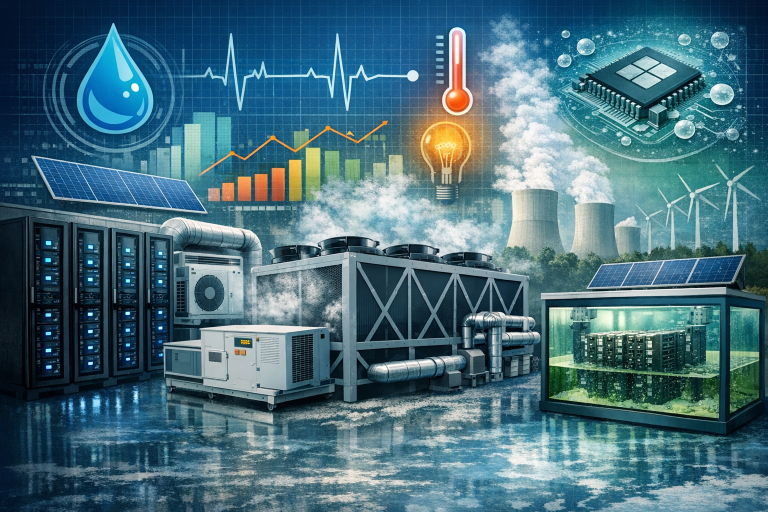
This report provides a primer on data center cooling equipment, offering both a foundational background and a current state-of-the-art review. It examines the cooling requirements and thermal standards that govern cooling system design, details modern cooling technologies, equipment configurations, industry best practices, and water use, and provides a high-level comparison across technology types. Perspectives from two major cooling equipment manufacturers are incorporated to ground the technical discussion in real-world design drivers and market context. The report concludes by surveying emerging cooling technologies and flexibility opportunities, identifying priority areas for future investigation. Ultimately, this primer is designed to provide the groundwork for a next-stage DCFlex Initiative report on data center cooling and flexibility.

On-Site Power Generation: Permitting and Compliance Considerations for Data Centers in the United States
This report outlines the rapidly evolving permitting landscape for on-site backup and primary power at U.S. data centers, where multi-jurisdictional air, noise, water, and land-use requirements increasingly shape project feasibility and timelines. Federal emergency-use limits, state and local modeling and emissions rules, and growing community scrutiny constrain operational flexibility and drive early strategic decisions on generator classification, fleet design, siting, and fuel commitments. Key insights emphasize front-loaded permitting, planning for regulatory uncertainty, cumulative-emissions impacts, location-dependent outcomes, and the long-term value of emerging fuels and technologies.

Potential Power Quality Impact and Monitoring Plan for Data Centers
This brief outlines the potential grid impacts of AI-DCs, their susceptibility to power quality disturbances, and touches on mitigation and monitoring strategies to ensure grid compatibility and operational resilience as computational demands continue to scale.
Reciprocating Internal Combustion Engines and Data Centers: Overview
This report provides a summary of engine types for DC power generation, reviews RICE use for both primary power and emergency backup applications, and then details information gathered on RICE use for DCs from multiple engine vendors and a provider of engine units.

Grid Flexibility Needs and Data Center Characteristics
This publicly-accessible white paper takes a first step toward developing a common understanding of flexibility between power providers, grid operators, and data center stakeholders