Interactive Map of Data Centers
Workstream Deliverables
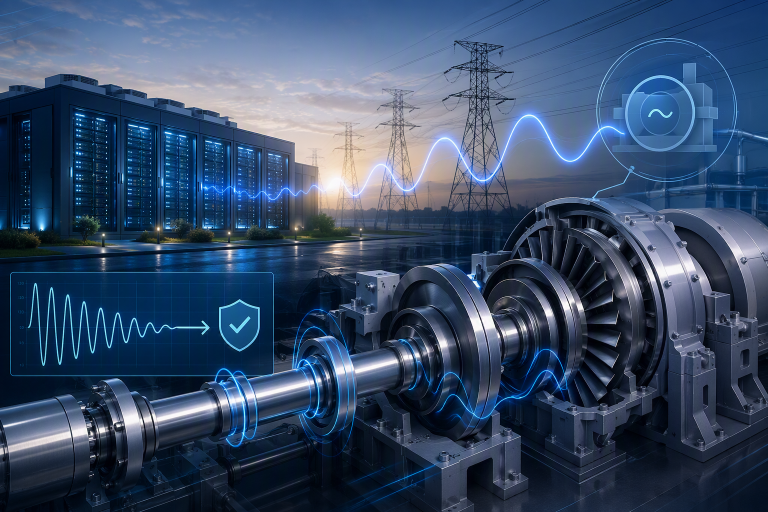
Managing Oscillating Load Impacts from Data Centers on Synchronous Machines: A Framework for Estimating Acceptable Load Oscillation Limits to Minimize Turbine-Generator Shaft Impacts
This report examines how data center load behavior may affect synchronous generator reliability. Large data centers, especially those supporting AI, can create cyclical and oscillatory demand patterns that differ from traditional loads and introduce new operational challenges. The report describes how these load oscillations can interact torsionally with synchronous turbine-generator shafts, amplifying mechanical stress, accelerating fatigue, and reducing reliability. It also presents a practical screening method and planning framework for assessing generator exposure with standard planning tools, along with guidance on mitigation, protection, and stakeholder coordination.
Quick Insight: NERC Level 3 Computational Load Alert: Actions and Pathways for Industry Support
This paper summarizes the NERC Level 3 Essential Action Alert issued in response to emerging reliability risks from large computational loads such as data centers. It outlines the seven Essential Actions addressing modeling, system studies, commissioning, protection coordination, disturbance analysis, and operational coordination.
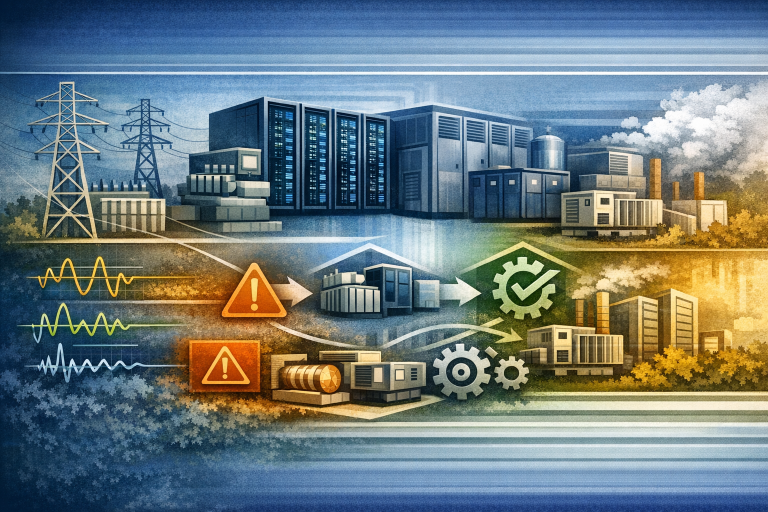
Large Load Ride-Through For Data Centers: Identifying Gaps in Requirements, Interpretation, and Compliance
This paper examines disturbance ride-through expectations for large data centers and identifies critical gaps in how current requirements are defined, interpreted, and implemented. While grid operators increasingly specify voltage and frequency ride through criteria at the point of interconnection, the paper shows that compliance is ultimately governed by facility-level architectures and equipment-level behavior. It highlights possible misalignment between system-level intent and internal facility responses arising from transformer connections, voltage measurement definitions, and unbalanced fault behavior. The paper clarifies how differences such as positive sequence versus worst phase voltage interpretation can materially alter compliance outcomes. It distinguishes grid-oriented ride through requirements from equipment immunity standards and demonstrates the absence of a consistent mapping between the two. Key challenges related to testing, certification, and verification of equipment and facility compliance are identified. The paper also highlights emerging reliability risks for data centers with tightly coupled onsite generation where load and generator ride through requirements are not coordinated. Practical design and coordination considerations are discussed for UPS systems, protection schemes, and cooling infrastructure. Drawing on lessons from IEEE 1547 and IEEE 2800, the paper outlines attributes of effective ride through requirements. It concludes by describing EPRI’s DCFlex initiative as a pathway to harmonize requirements, improve traceability, and establish practical compliance and certification approaches to support grid reliability at scale.

Assessing Subsynchronous Torsional Interactions with Respect to AI Training Loads
This report examines the emerging risks associated with subsynchronous torsional interactions (SSTI) between turbine-generator shafts and the variable, high-power loads produced by AI data centers, especially during intensive training activities. The document outlines the physical mechanisms through which fluctuating electrical demands can stimulate generator torsional modes and introduces a screening approach based on interharmonic current gains to determine when comprehensive data collection and assessment are warranted.

Regional Load Interconnection Requirements: Volume II
The industry is currently facing a significant increase in large load interconnection requests, primarily driven by the rapid expansion of data centers. This surge has sparked considerable interest in understanding the specific interconnection requirements for these substantial loads. This Volume II installment aims to provide reporting on the evolving landscape of interconnection requirements for large loads.

Reliability Guideline: Risk Mitigation for Emerging Large Loads
This document summarizes the North American Electric Reliability Corporation (NERC) guideline on Risk Mitigation for Emerging Large Loads, focusing on the reliability challenges posed by data centers, cryptocurrency mining, hydrogen electrolyzers, and other power-intensive facilities. These loads introduce rapid demand variability, oscillations, and operational risks that require proactive measures across interconnection, planning, operations, stability, power quality, and resilience. The guideline emphasizes standardized data collection, formalized interconnection processes, advanced planning methodologies, and collaborative approaches among transmission operators, planners, balancing authorities, equipment manufacturers, and large load entities. EPRI’s initiatives, including DCFlex and resource adequacy modeling, support industry readiness by enhancing forecasting, reserve strategies, and dynamic modeling. Ultimately, the guideline calls for large load entities to transition from passive consumers to active partners in ensuring Bulk Power System reliability and resilience.