
Staff Workstream 1

Full Staff List











Testimonial Slider
Chris Crosby
CEO
As a nation, we cannot afford to fall behind on AI. We need to invest in sustainable infrastructure to support big data applications, but not at the expense of other consumers of electricity, Compass is working collaboratively with our utility partners on planning and grid expansion, and glad to invest in EPRI’s research to bring forward long-term solutions.
Joe Dominguez
President and CEO
Data centers are integral to our daily lives, economy, and national security. Our energy system is built to handle the extreme demands of our hottest summer days and coldest winter nights but is often underutilized. The real challenge isn't a lack of energy for data centers but managing the peak demand hours. The ability of data centers to flex during these critical periods is crucial, We commend EPRI for launching this initiative and bringing together key industry representatives to meet growing data center power demands, enhance grid reliability, and advance the clean energy transition.
Venkat Tirupati
Vice President, DevOps and Grid Transformation
Data center loads present interesting challenges and opportunities for grid planning, operations, and markets. DCFlex will provide an important forum for discussion on these topics as it brings all the stakeholders together towards successful data center integration into the grid.

Barbara Hampton
President and CEO
Georgia Transmission is excited to be part of this collaborative effort. As a cooperative, we believe that challenges are best solved together. As we look to the future, the demand for safe, reliable and cost-effective electricity will only continue to grow. Participating in initiatives like EPRI DC Flex helps to ensure we continue to leverage and explore the best technological solution to deliver on our commitments to our members.
Caroline Golin
global head of Energy Market Development and Innovation
At Google, we see this moment as a generational opportunity for the public and private sector to work together to meet energy demand responsibly and unlock significant benefits for people, the economy and the planet, Through the leadership, expertise, and convening power of EPRI, DCFlex will be an important collaboration vehicle to align our common goals, as we work together to build a stronger electrical grid for all.

Bryce Dalley
Director of Commercial Energy Supply
Meta is committed to efficient data center operations matched by 100 percent clean and renewable energy. But we know this work cannot be done alone — we continue to work alongside our peers and utility providers to advance new opportunities for digital infrastructure. Efforts like EPRI’s DCFlex initiative are critical to these cross-industry efforts.
Marc Spieler
head of global business development and strategy for the energy industry
AI can help solve the world’s greatest problems, and to enable this, NVIDIA is committed to our leadership in providing the highest performance per watt for AI computing infrastructure, The DCFlex initiative is another example of how industry leaders can leverage data centers as a flexible resource on the grid to help address peak loads.

Xavier Piechaczyk
President of the Managing Board
As the demand for grid connections from hyperscalers grows exponentially in France, RTE must match the electric consumption of their algorithms with the power system constraints to accelerate the connection process. Full-scale experimentations of DC-flex project will demonstrate the technical feasibility of datacenter flexibility solutions and will guide innovative grid connection solutions.

Jim Burke
President and CEO
As we serve our customers and meet their rapidly changing needs around reliability, affordability, and sustainability, we believe load growth from data centers presents a crucial opportunity to bring together stakeholders across the power and technology sectors to help solve some of the most complex grid management issues, Vistra is pleased to invest in EPRI’s DCFlex initiative and looks forward to working with other innovative companies to answer the call in ways that advance our national and regional interests and ensure the grid is reliable for all customers.
Member Logos















Deliverables by Workstream

(Public) Designing for Flexibility: How Onsite Gen, Energy Storage, and Flexible Cooling Technologies Align With Different DC Flexibility Needs
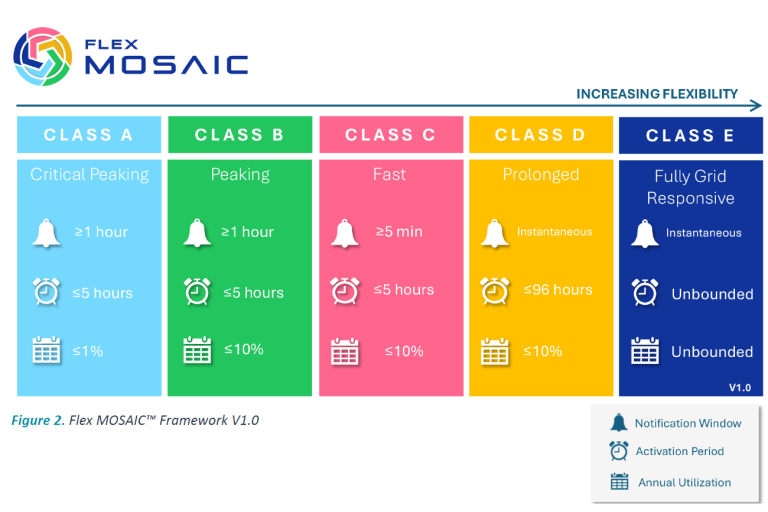
This Quick Insight examines the design considerations involved in relating data center flexibility needs to onsite generation, electrical energy storage, flexible cooling, and thermal energy storage. Its scope uses the technology-neutral EPRI Flex MOSAIC™ classes A–E as a framework organized by notification, activation duration, and annual utilization requirements.
Flex MOSAIC™: A Framework to Unlock Large Load Flexibility and Increase Speed to Power
Introduces Flex MOSAIC™, a technology-neutral framework for describing and evaluating large-load flexibility using standardized classes based on notification window, activation period, and annual utilization. The framework creates a common language for aligning facility capabilities with grid needs, supporting more consistent planning, interconnection, and operational decisions that can help accelerate access to power while maintaining reliability.

Data Center Cooling: Implications for Data Center Flexibility
Cooling systems account for 30–40% of data center load yet remain one of the least-utilized resources for grid flexibility today. This report evaluates how modern cooling architectures can provide dispatchable, demand flexibility without impacting data center information technology equipment’s reliability and operation. Findings show that ride-through can be extended from seconds to tens of minutes or more through thermal mass, precooling, setpoint relaxation, and thermal energy storage (TES). Case studies demonstrate practical strategies such as precooling, fan/pump turndown, cold TES, adsorption cooling, and free-cooling time-shifting. Interviews with Schneider Electric and Vertiv highlight that cooling flexibility is most valuable when it accelerates interconnection, increases information technology capacity, or improves resilience. For DCFlex Initiative members, the report provides a framework for designing demonstrations that quantify shift, shed, and shape services and position cooling as an active grid-support asset.

Onsite Generation Options for Data Centers: Implications for Data Center Flexibility
Rapid growth in artificial intelligence and high-density digital workloads is driving unprecedented demand for new data center capacity, but grid interconnection delays and transmission constraints increasingly limit the ability to secure reliable power. As a result, onsite generation, ranging from uninterruptible power supply systems and emergency backup generators to peaking units, primary power, and bridging power, has become central to data center design. This report inventories onsite generation technologies, evaluates their flexibility potential, and maps each to EPRI’s Flex MOSAIC™ classification framework. The analysis shows how onsite generation assets can potentially accelerate speed-to-power, meet interconnection requirements, and provide grid-supportive services such as net-load reduction, reserves, and fast frequency response. The report provides a structured foundation for utilities, regulators, data center owners and builders, and other stakeholders to plan onsite generation that enhances both data center reliability and grid stability by providing flexibility.

Energy Storage Options for Data Center Flexibility: Aligning Energy Storage with Data Center Flexibility Needs
This report surveys the landscape of energy storage technologies applicable to data centers and evaluates their fit against EPRI’s Flex MOSAIC™ framework for characterizing large-load flexibility. It reviews electrochemical, mechanical, and thermal energy storage options, covering process descriptions, technology readiness, and key performance metrics. The report then maps these technologies against Flex MOSAIC’s five flexibility classes, identifying which storage types are best suited to each class’s notification, duration, and utilization requirements. The report shows that no single storage technology satisfies the full range of data center flexibility needs; instead, a layered architecture combining short-duration technologies for power quality and fault ride-through with long-duration technologies for prolonged capacity and resilience offers the most practical path forward. This report is intended to help EPRI’s DCFlex Initiative members evaluate energy storage options as part of a broader data center flexibility strategy.

(Public) Tech In Focus: Jenbacher Spark-Ignition Engines
This Quick Insight provides an overview of Jenbacher J620, J624, and J920 spark-ignition engines for data center onsite generation. Its scope includes emergency backup, bridging, primary power, peaking, and combined heat-and-power applications, including data center cooling. The solution maturity discussion addresses natural-gas, biofuel, and hydrogen operation.
Industry News
DOE seeks input on shoring up grid for data centers
Southwest Power Pool approves accelerated large load interconnection policy
Entergy expects data centers to drive 13% near-term annual sales growth: CEO
As PJM prices rise, flexibility can't be ignored
PJM stakeholders overwhelmingly pan proposal for data center interconnection
Google expands demand response to target machine learning workloads
Data center flexibility can save money but may come with higher emissions: MIT
Who Pays? AI Boom Sparks Fight Over Soaring Power Costs
How New GB300 NVL72 Features Provide Steady Power for AI
Speaking Engagements
NASUCA Annual Meeting
Speaking: David Porter
NASUCA is an association of 63 consumer advocates in 45 states and the District of Columbia Barbados, Puerto Rico, and Jamaica. NASUCA’s members are designated by the laws of their respective jurisdictions to represent the interests of utility consumers before state and federal regulators and in the courts.
Location: New Orleans | Louisiana
Date: Nov 15 - Nov 18
RE+26 "Renewing What's Possible"
Speaking: Jessica Lin
RE+ brings the modern energy industry together to meet the power demands of the future. What began as Solar Power International (SPI) has evolved into RE+, uniting an extensive alliance of renewable energy leaders for multiple days of programming and networking opportunities, while showcasing a resilient industry. As the largest and most comprehensive event in North America for the clean energy industry, RE+ incorporates business opportunities and education content across energy sectors, including solar, energy storage, hydrogen, microgrids, EV charging and infrastructure, and wind energy.
Location: Las Vegas | NV
Date: Nov 16 - Nov 19
Data Centres Ireland
Speaking: Eamonn Lannoye
Now in its 16th year, DataCentres Ireland is the country’s leading event for the data centre sector, bringing together key decision-makers, operators, service providers, and innovators. Combining a free-to-attend exhibition with a multi-streamed conference, it’s your opportunity to discover the latest technologies, share ideas, and shape the future of Ireland’s digital infrastructure.
Location: RDS | Dublin
Date: Nov 18 - Nov 19
2nd Annual Conference Energy Needs of Data Centres UK
Speaking: Eamonn Lannoye
Strong hyperscale commitments and national AI targets have positioned the UK as a major destination for data centre investment. As the pipeline of projects grows, access to sufficient and competitively priced electricity has become the principal bottleneck to translating that ambition into built capacity.
Since the first edition in November 2025, when we convened to examine the energy challenges facing the UK’s data centre sector, the discussion has moved from urgent to critical. Policy and regulatory responses have accelerated, alongside emerging industry initiatives to develop solutions. The conference will bring together the operators, developers, utilities, policymakers, and investors to address challenges and identify solutions to support the UK’s digital infrastructure expansion.
Location: London | UK
Date: Nov 26 - Nov 26